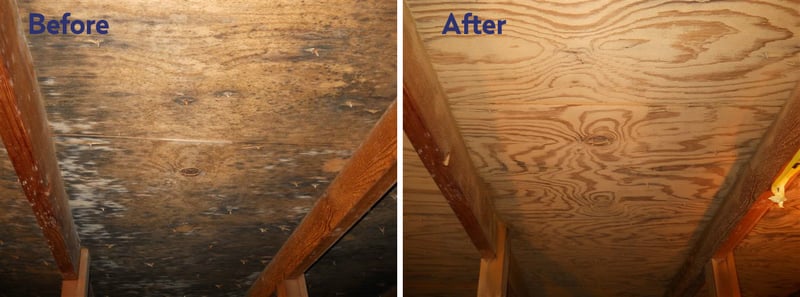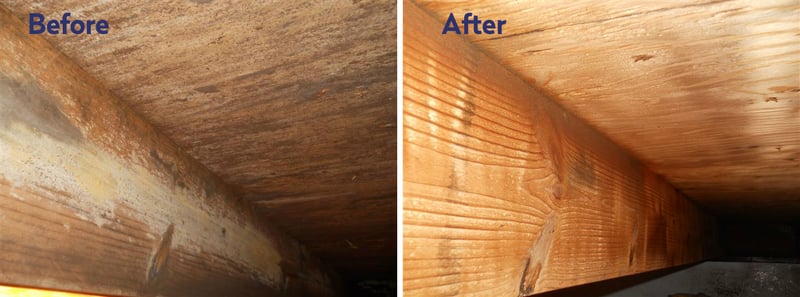
Sanding spreads spores. Biocides add chemicals to a moisture problem. Dry ice removes 99.9% of mold spores from wood without water, without chemicals, and without tearing out structural material. Insurance-billable.
The thermal shock and mechanical action of dry ice removes mold from porous wood surfaces more completely than any other method — reaching deep into grain where chemicals and scrubbing cannot.
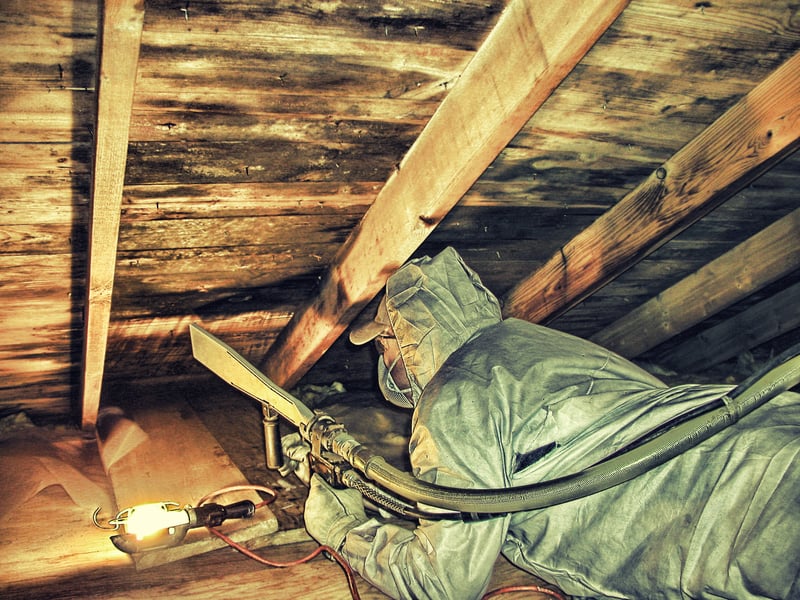
2,451 sq ft residence — mold removal from attic framing, floor joists, and structural members. Highest per-square-foot restoration job completed to date. Fully insurance-billable with complete documentation provided.
Traditional mold remediation methods treat the symptom. Dry ice addresses the cause — reaching into porous substrates where mold hides, and destroying it there.
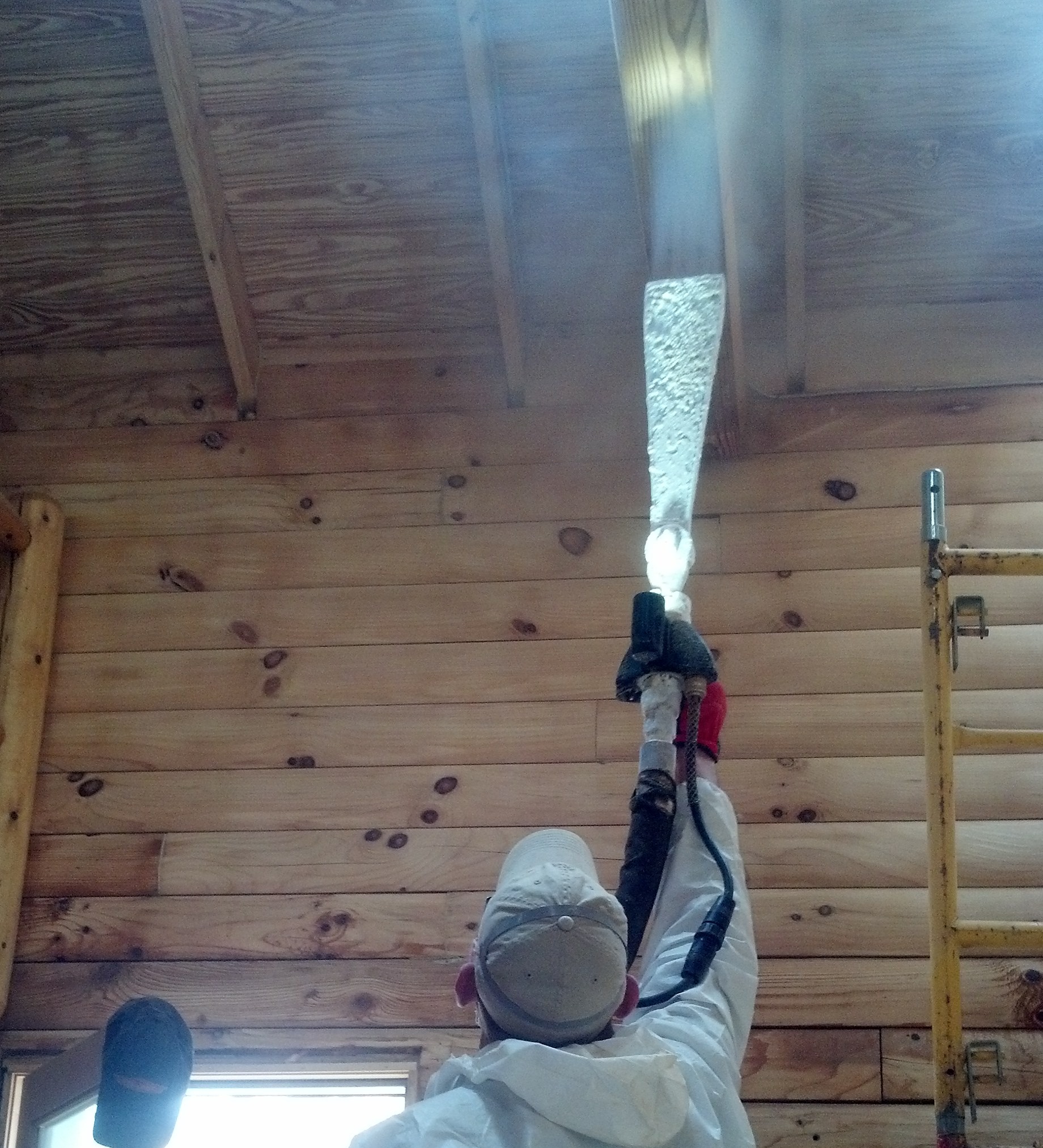
Dry ice blasting reaches -109°F on contact, creating a thermal shock that kills mold colonies and denatures the spores simultaneously. Not just removed — destroyed. Chemical treatments only inhibit; dry ice eliminates.
Mold embeds itself in wood fibers. Wire brushing and sanding remove only the surface layer — the colony regrows. Dry ice thermal shock penetrates the grain, dislodging mold from within the material itself.
Sanding and wire brushing are notorious for launching viable spores into the air and adjacent areas. Dry ice kills spores at point of contact before they become airborne. Safer for workers and occupants.
Chemical biocides leave residue in the wood — a concern for future occupants, especially in residential settings. Dry ice leaves nothing behind. The surface is clean, the structure is intact, and the space is immediately safe.
Sanding removes wood material, weakening framing. Dry ice is non-abrasive — it removes only the contamination, leaving the structural member fully intact. Critical in attics, crawl spaces, and floor systems.
Dry ice remediation is accepted by major property insurers. We provide full documentation — before/after photography, scope reports, and remediation certification — so your claim is properly supported.
Mold appears in confined, hard-to-reach spaces. Dry ice equipment accesses every area — without tearing out materials that don't need to come out.
Clean mold from roof deck, rafters, ridge boards, and sheathing — the most common residential mold location. No tear-out, no replacement lumber required in most cases.
Mold in crawl spaces affects floor joists, blocking, rim joists, and subfloor. We reach every surface in confined spaces where traditional equipment can't operate effectively.
Remove mold from concrete block, poured concrete, wood framing, and OSB in basement environments — where moisture intrusion is chronic and remediation is often repeated unnecessarily.
Mold in HVAC systems circulates spores throughout the entire property. We clean air handlers, coil cabinets, ductwork, and plenums — stopping recirculation at the source.
Wherever mold has grown on accessible structural components — studs, plates, headers, and sheathing — dry ice removes it without the demolition that other methods require.
Apartment buildings, hotels, office buildings, and commercial properties with mold in mechanical spaces, framing, and HVAC systems. We work around tenant schedules and business operations.
Alpine integrates with your existing remediation workflow — as a subcontractor, preferred vendor, or direct provider.
We subcontract to restoration and remediation companies throughout Greater Phoenix. We reduce your crew requirement, shrink your timeline, and eliminate biocide handling — so you can close the job and move to the next one faster.
Less demolition means lower claims. Dry ice remediation typically saves $7,626 per project vs. traditional methods. We provide before/after photography and scope reports formatted for major claim management platforms.
You don't need to gut your walls to beat mold. Dry ice reaches into joists, behind framing, and along surfaces that sanding can't touch — without adding the one thing that feeds mold: water. We assess, quote, execute, and document everything for your claim.
Both. The rapid thermal shock of dry ice (-109°F) kills active mold colonies on contact, destroying cell walls and denaturing spores simultaneously. The mechanical action then removes the dead mold and spore debris from within the substrate. It's the only method that addresses both the surface contamination and the embedded colony in a single pass.
No. Dry ice kills spores at the point of contact before they become airborne — unlike sanding or wire brushing, which are notorious for launching viable spores into the air and adjacent areas. For large-scale jobs, we use standard containment protocols as an additional precaution.
Yes. Dry ice blasting is a recognized and insurance-accepted remediation method. We provide full before/after documentation, scope of work reports, and can format deliverables to match your adjuster's or restoration company's requirements.
Yes — these are among our most common applications. Attic framing, roof decking, floor joists, and crawl space structures are ideal for dry ice remediation. Our equipment accesses confined spaces effectively, and we leave no residue or moisture behind.
Dry ice blasting eliminates the existing mold colony — but mold requires moisture to grow. If the underlying moisture source is not addressed, new mold can grow on previously clean surfaces. We recommend coordinating dry ice remediation with moisture control improvements (vapor barriers, ventilation, waterproofing) for a permanent solution.
Residential mold remediation projects typically range from $3,000 to $25,000+ depending on the affected area, location in the structure, and overall scope. Our Mesa, AZ job — 2,451 sq ft of attic and structural framing — was completed at a competitive rate. Smaller crawl space or localized attic jobs can start at $2,500–$5,000. The work is insurance-billable in most cases, meaning your out-of-pocket cost may be minimal. We provide a free quote within 2 hours of your inquiry.
No. Dry ice rates 1.5–2 on the Mohs hardness scale (out of 10) — softer than wood itself. The cleaning action is driven primarily by thermal shock and rapid sublimation, not abrasion. It removes mold and contamination without altering the wood substrate beneath — preserving structural integrity that sanding or grinding would compromise.
Dry ice is solid carbon dioxide (CO₂) formed into small pellets approximately 3mm in diameter. The CO₂ used is reclaimed and recycled — a byproduct of industrial processes, not newly produced. On contact with a surface, it sublimates directly from solid to gas, expanding 800x in volume. No liquid phase. No residue. No moisture — which is critical for mold remediation.
Minimal. Dry ice itself disappears entirely — it sublimates to CO₂ gas. What remains is only the removed mold debris and spore material, which is collected and disposed of per remediation protocols. There is no blast media to sweep, no moisture to dry, and no chemical residue to neutralize.
Available throughout Maricopa County for mold remediation, attic cleaning, crawl space work, and structural framing remediation. We travel for the right jobs.
Outside this area? Call us — we travel for the right jobs. (480) 256-8092
Tell us where the mold is and we'll respond with a custom quote within hours. We work directly with homeowners, restoration companies, and insurance adjusters.
We'll be in touch within 2 hours. For urgent situations, call (480) 256-8092.